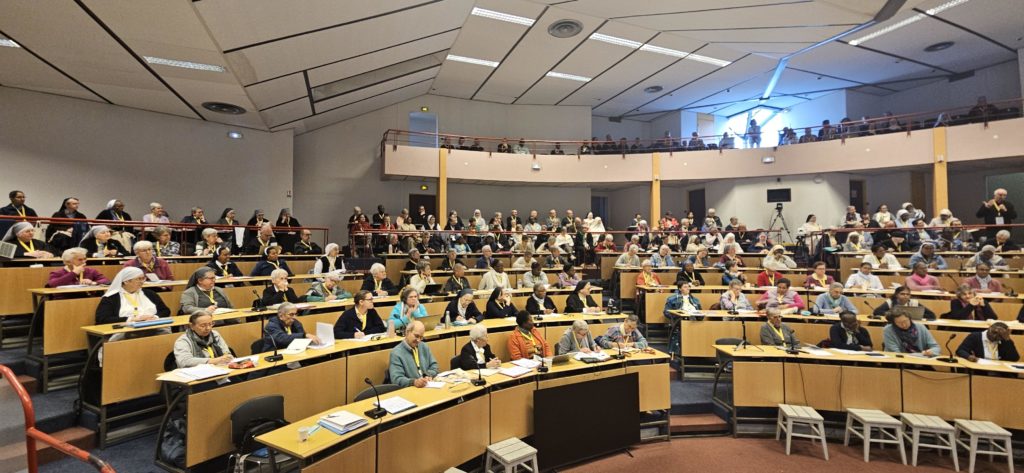
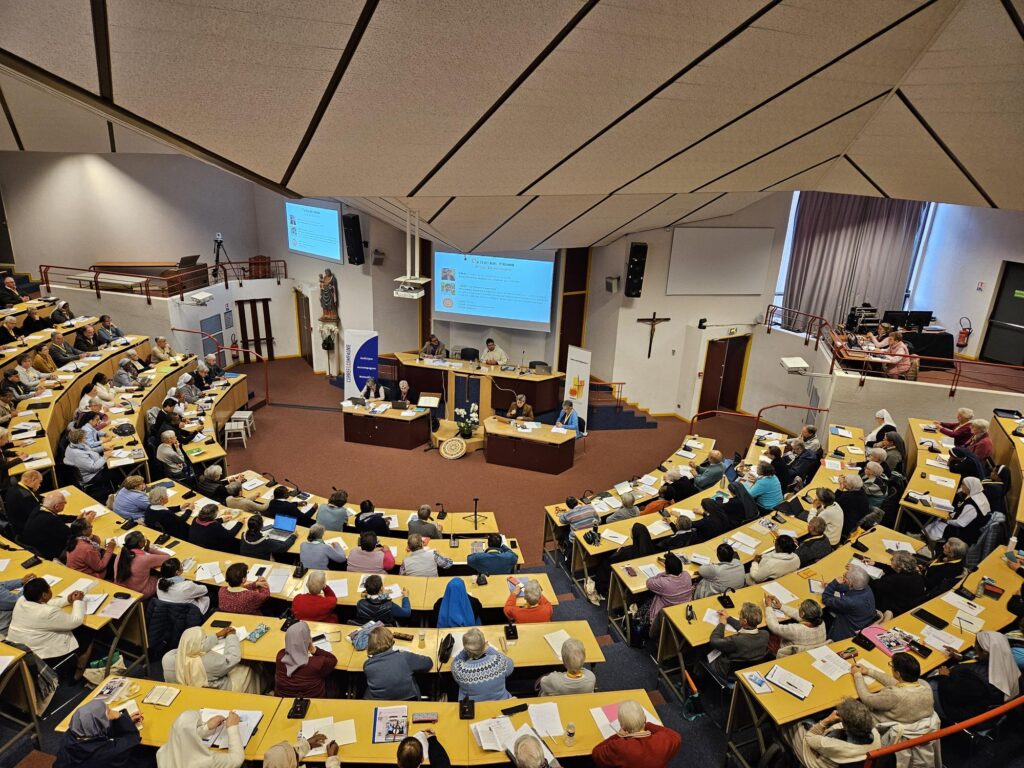
LOURDES — Roughly 350 male and female major superiors gathered in Lourdes from 18–22 November for the CORREF General Assembly, a meeting marked by continued efforts to strengthen safeguarding practices within religious life in France.
Sr. Tosca Ferrante and Claudia Giampietro attended on behalf of the Commission, following a year of sustained collaboration with CORREF in the context of the Annual Report’s work with religious congregations. Representatives of the Dicastery for the Institutes of Consecrated Life and Societies of Apostolic Life were also present, adding to the exchanges aimed at reinforcing cooperation between religious institutes and Church authorities.
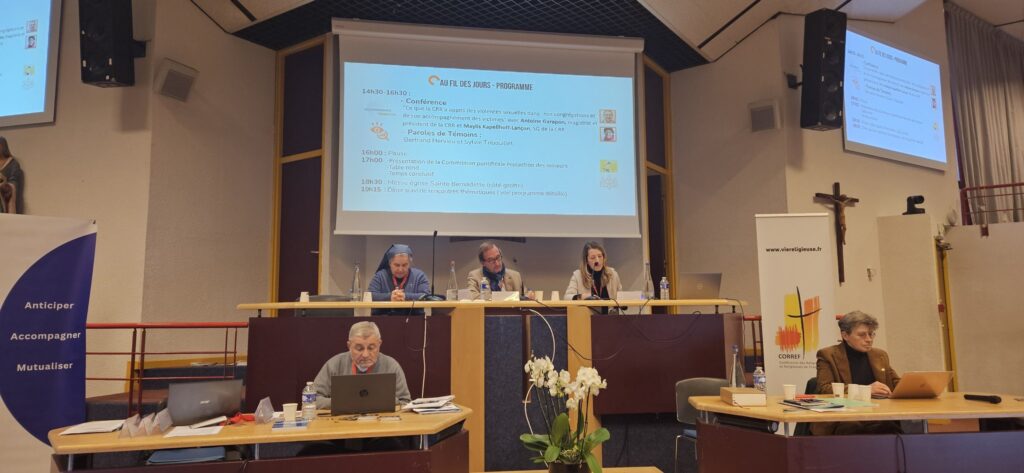
The assembly’s central day on 20 November opened with an early prayer service at the Église Sainte-Bernadette. Entitled “Chemin de croix: de victimes à témoins” (“Way of the Cross: from Victims to Witnesses”), the liturgy invited participants to reflect on the suffering endured by victims and the call to transformation within the Church. Guided by the artwork The Cross of Christ, Broken and Shattered by Maite Duruc, the community listened to Gospel stations paired with accounts from victim-witnesses, accompanied by cellist Stéphanie Carrillon.
Fr. Pierre Tritz, Fils de la Charité, offered a homily centred on the mercy of God present in the wounded Body of Christ, emphasising the Church’s responsibility to confront abuse with truth, accountability and hope. The prayer concluded with a contemplative dance performed by Raphaëlle Hubin.
The morning sessions continued with the presentation of Faire face – Le monde religieux en France après la Ciase (“Facing Reality – Religious Life in France after the Ciase”), a study examining how religious congregations in France are advancing in safeguarding, transparency and formation since the publication of the 2021 Ciase report.
In the afternoon, discussions shifted to the experience of the French Commission for Recognition and Reparation (CRR), with speakers outlining the evolving processes of accountability and restitution, as well as the broader transformation taking place within religious communities.
Sr. Tosca and Giampietro participated in a roundtable highlighting the mission of the Commission and the importance of placing victims’ voices at the centre of its work. Several victims and survivors who contributed to the Second Annual Report — including individuals from AMPASEO — attended the session and voiced their commitment to ongoing collaboration. Their interventions were met with reflections from six major superiors currently engaged in structured work with the CRR, who described the difficulties and progress experienced within their own congregations.
The exchange underscored a shared determination to address abuse with clarity and cooperation, and to continue building safeguarding practices grounded in transparency and the lived reality of victims and survivors.
At the end of the Assembly, several participants highlighted the decisive role played by Sister Véronique Margron throughout her nine years as president of the CORREF, a mandate she has just completed. Her continued commitment, her clear-sighted words deeply rooted in listening to victims, as well as her ability to foster demanding dialogue between religious congregations, ecclesial authorities and civil society, have significantly shaped the reflection and action of religious institutes in France.
It was in this context of transition and reflection that we asked her how she looks back on her nine years as president of the CORREF, and on the transformations undertaken within religious life in the areas of truth, responsibility and protection.
“Over these nine years, I believe I can say that the CORREF has profoundly changed. The commitment to the CIASE, the decision to establish the Recognition and Reparation Commission, the listening to numerous victims, the presence of victim-witnesses at our assemblies; the many working groups, the training sessions — all of this has, I believe, set the CORREF and its members in motion, even into battle. The institutional responsibility of religious life had been affirmed even before the publication of the CIASE report. Beyond these realities, it is the major superiors themselves who have changed, who have grasped the gravity of the situation, the imperative of responsibility, and the necessity of truth. Nothing is won, and the temptation to ‘turn the page’ is never far away. In this struggle, we can never say ‘it’s over’, ‘everything is done’. Transformations and conversions will always need to begin again.”
We also asked her about the main challenges and priorities today for continuing to build a genuine culture of protection within religious institutes.
“The first challenge is to continue, not to grow weary, to refuse any return to denial, and to remain proactive. Then it is to address understanding and training on all forms of abuse, especially abuses of trust, authority and spiritual abuses. It is also to try to support the transformation of the communities themselves, not only that of the major superiors, and to continue working not only with the Conference of Bishops but also with civil society. Finally, we must intensify theological work on the manipulation of ‘the sacred’, of vows, of Christian virtues, and everything that contributes to the systemic nature of abuses and violence.”
0 Comments