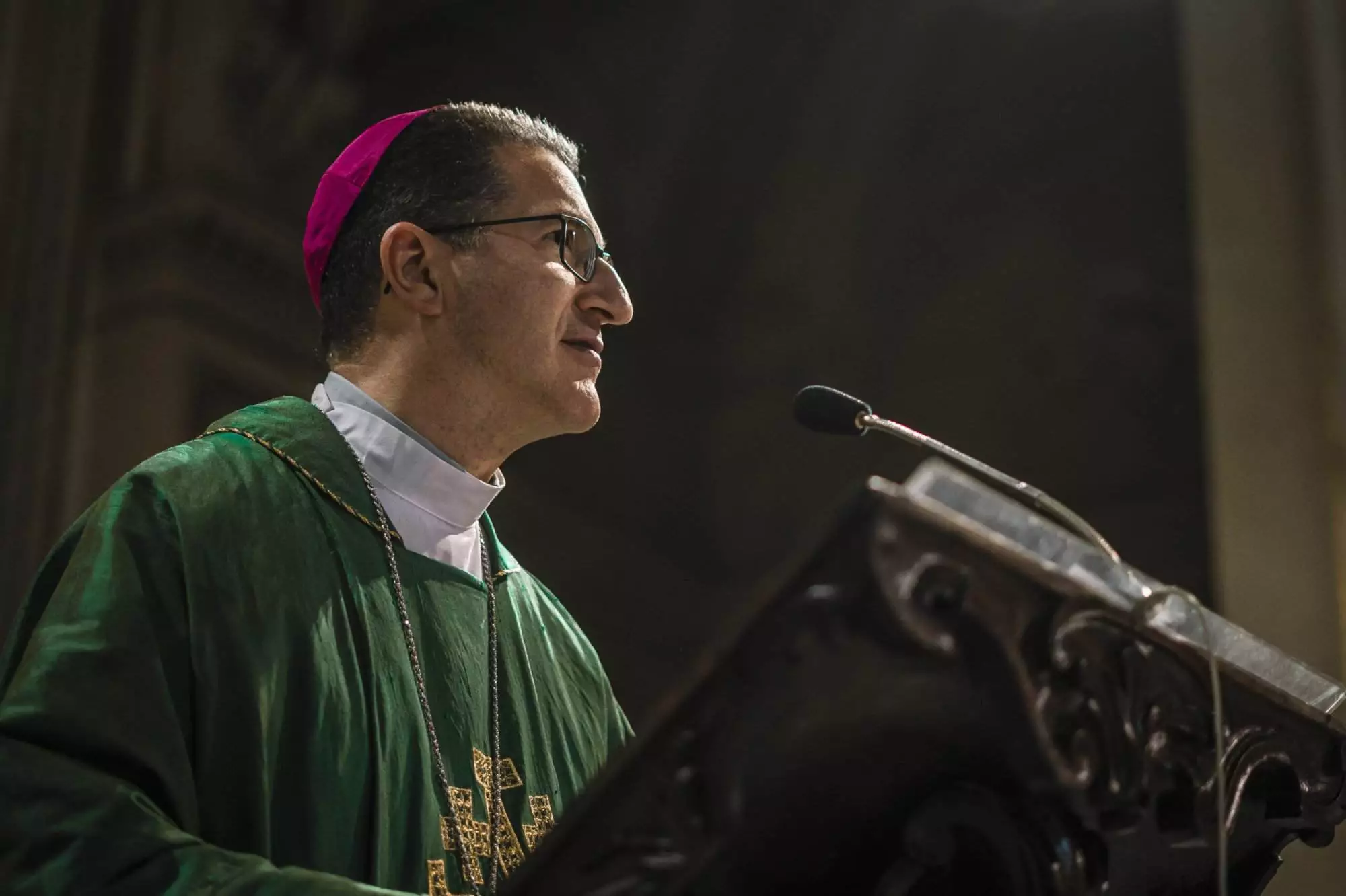
The latest episode of the Commission’s Inside Safeguarding Podcast is an extended conversation with Secretary of the Pontifical Commission for the Protection of Minors, Bishop Luis Manuel Ali Herrera, a figure recognised for clear teaching on the pastoral imperative of protecting children and vulnerable people from harm, survivor accompaniment and the long haul of culture change.
VATICAN CITY – When Monsignor Luis Manuel Alí Herrera speaks about safeguarding, the language is never abstract. It is shaped by years of proximity to people whose lives were marked by abuse within the Church. This month, he sat down with William Roberts from the Inside Safeguarding podcast for the special end-of-year retrospective episode, and he reflected on a year of transition and reform. Today, as Secretary of the Commission, Mons. Alí is widely regarded as the man driving the engine of safeguarding reform at the Vatican. The role has placed him at the centre of some of the Church’s most demanding work, requiring steady institutional labour and close pastoral attention.
A vocation forged in encounter
Mons. Alí’s path into safeguarding began in Bogotá, where he served as a formator at the major seminary, responsible for the psychological and pastoral accompaniment of seminarians. During those years, survivors of abuse came to him with their stories. The encounters were unsettling, painful, and transformative. They revealed what he has described as a reality the Church could no longer afford to confront only in fragments or in silence.
Safeguarding, for Mons. Alí, emerged as a vocation. When Pope Francis later asked him to join the Commission, he accepted without hesitation. His episcopal ordination followed soon after, a coincidence he has noted as emblematic of the direction his ministry would take: authority bound inseparably to responsibility for protection and care.
Pope Francis’ legacy: listening as reform
The death of Pope Francis earlier this year inevitably cast a long shadow over the Jubilee. For Mons. Alí, reflecting on that pontificate means returning to a single, decisive intuition: the conviction that victims must be listened to with empathy and respect.
He recalls a moment from the earliest months of Pope Francis’ papacy, before the Commission even existed, when the Pope welcomed survivors to the Casa Santa Marta. That encounter, he said, marked a turning point. It was then that the Holy Father upheld that safeguarding required truth, justice and full reparation, not merely expressions of regret.
From that listening flowed reforms that reshaped the Church’s legal and pastoral landscape: the motu proprio Come una madre amorevole; the lifting of pontifical secrecy in abuse cases; the revision of penal law; updated procedural norms; the safeguarding guidelines of Vatican City State; and the global summit of 2019 that led to Vos estis lux mundi. Safeguarding became one of the defining pillars of Pope Francis’ pontificate, alongside synodality, care for creation and a renewed emphasis on mercy.
A new pontificate, a shared priority
The election of Pope Leo XIV in May introduced a different personality and leadership style, yet Mons. Alí has been attentive to the continuity that matters most. In the first months of the new pontificate, safeguarding has remained visibly present.
He points to concrete gestures rather than general statements: a letter to journalist Paola Ugaz in Peru; a message addressed to the bishops of the Philippines during their first national safeguarding assembly; written reflections prepared for a Jubilee prayer service for victims; and meetings in Rome with survivors from Belgium and from the Sodalitium movement.
What stands out, Mons. Alí explains, is Pope Leo’s insistence that accompaniment of victims cannot be delegated exclusively to Rome. While remaining available to survivors, the Pope has consistently reminded bishops that safeguarding is the responsibility of every local Church: pastoral, structural and ongoing.
Working within the Curia, clarity of mandate and habit of dialogue
Few figures are better placed than Mons. Alí to observe how safeguarding has taken root within the Roman Curia itself. Over more than a decade, he has witnessed a gradual but tangible shift.
In the Commission’s early years, its mandate was often misunderstood, and collaboration could be uneven. That changed with Praedicate Evangelium, which clearly defined the Commission’s role. Since then, structured dialogue has developed with the Secretariat of State and with the dicasteries responsible for doctrine, clergy, bishops, consecrated life and the laity.
One initiative from the past year stands out as emblematic of this cultural change: the first safeguarding course ever organised for employees of Vatican City State. Eighty staff members from across departments took part, a practical sign that safeguarding is no longer perceived as an external requirement, but as an internal responsibility.
A bridge to the local Churches
Globally, Mons. Alí remains realistic about disparities in how safeguarding norms are applied. Progress is uneven, shaped by cultural, economic and historical factors. Yet the Commission’s role, as he sees it, is precisely to act as a bridge between Rome and local Churches.
Over the past year, that bridge has been reinforced through extensive travel. Together with the Commission’s President, Mons. Alí undertook what he has described as marathon of visits across Africa, Asia, Europe and the Americas. These encounters involved reviewing safeguarding protocols, meeting with bishops’ conferences, listening to victims’ groups and gaining first-hand insight into local realities.
Such visits, he notes, allow the Commission to move beyond assumptions, identifying both genuine progress and areas where support, formation or accountability remain lacking.
Looking ahead: safeguarding as mission
When invited to look five or ten years into the future, Mons. Alí avoids predictions about his own path. Instead, he speaks of hopes shared within the Commission. Safeguarding, he believes, must become a standard element of pastoral planning everywhere, discussed with the same seriousness as synodality, evangelisation and care for the poor.
Current study groups within the Commission are already pointing towards emerging challenges: vulnerability in its many forms; digital environments; online behaviour; and the ethical risks posed by AI. Upcoming annual reports will address safeguarding in religious life, questions of justice, and institutional renewal. Preparations are also underway to ensure that World Youth Day 2027 in South Korea visibly integrates safeguarding as a positive expression of the Church’s mission.
Beyond policy
What ultimately emerges from Mons. Alí is not a technocrat, but a pastor formed by listening. His confidence in the Church’s safeguarding journey is neither rhetorical nor naïve. It is rooted in years spent accompanying survivors, navigating institutions, travelling extensively, and witnessing the commitment of people across continents who labour, often quietly, to build a safer Church.
Safeguarding, in his words, is not an appendix to the Gospel. When lived with integrity, it becomes one of its clearest proclamations.
Editorial notes
- This interview was recorded on 9 December 2025 for the Inside Safeguarding podcast. Quotations from Bishop Ali were originally delivered in Spanish;
0 Comments