
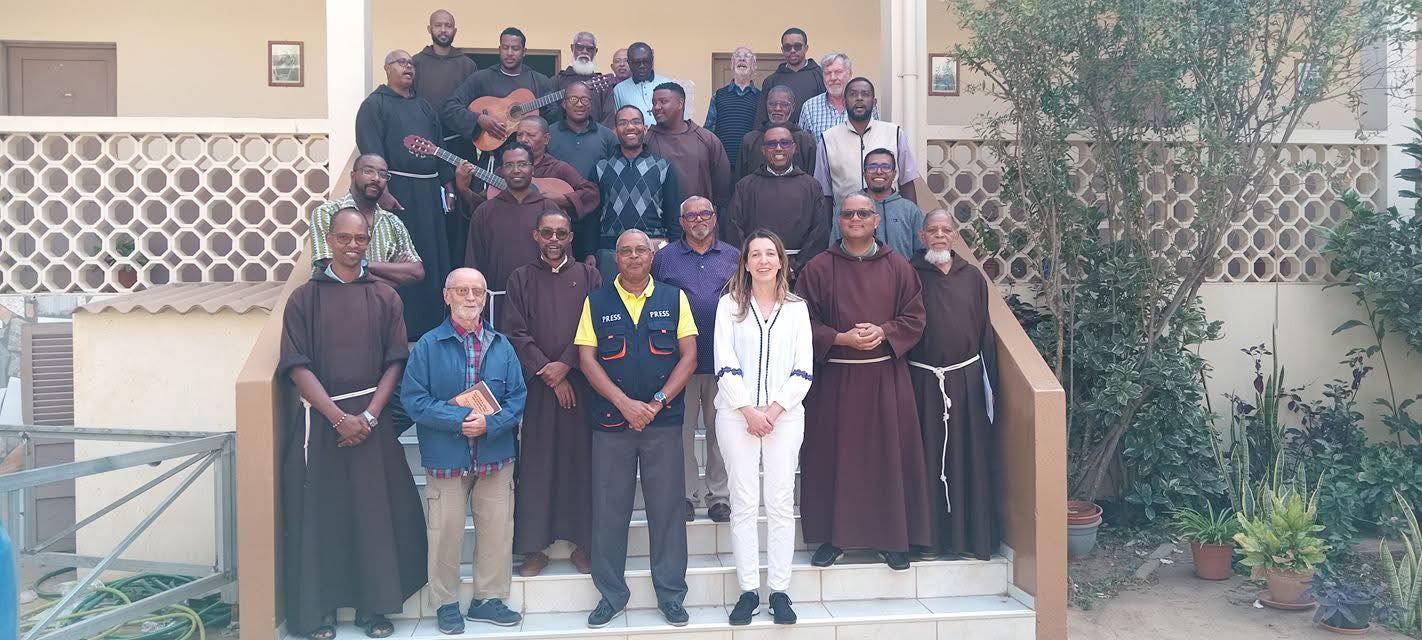
MINDELO, CAPE VERDE – From 13 to 17 January 2026, the Capuchin Custody in Cape Verde gathered at the Domus Ordinis on the island of São Vicente for its annual week of ongoing formation, this year focused on the care of minors and vulnerable persons. The session was convened by Fr. Gilson Frede Barros Pina, OFMCap, Custos of the Custody, and brought together friars serving across the islands and in the Custody’s wider mission, including São Tomé and Príncipe.
Around 30 friars took part in the programme. Claudia Giampietro, Regional Expert for Europe of the Commission, travelled to Cape Verde to lead three days of intensive training, and remained involved throughout the week’s wider activities and pastoral encounters.
The formation sought to strengthen a shared safeguarding culture that is faithful to the Church’s mission and grounded in the daily realities faced by communities and ministries. Participants reflected on how vulnerability appears in the lives of those they serve, and on dynamics that can arise within community life, including authority, communication, boundaries, and the responsible use of power. From there, the sessions moved into practical work: how to recognize risk factors early, how to create safer environments in everyday pastoral and educational settings, and how to accompany complex situations with greater clarity and competence.
A consistent theme in the friars’ feedback was the sense of being encouraged and better equipped: learning how to notice situations that require attention, how to respond with greater awareness of consequences, and how to take seriously that for victims and survivors there is often a profound “before and after” that shapes life and relationships. The training also supported a more proactive approach to prevention, particularly in ministry with children, where safe spaces and clear, consistent practices matter as much as good intentions.

Climate pressures and “new” vulnerability
One of the realities repeatedly named during the week was that vulnerability is shaped not only by personal histories and social conditions, but also by the environment. Cape Verde is exposed to recurring drought and water stress, with major consequences for families, livelihoods, and access to basic services.
In many places, people speak of long periods without meaningful rain. At the same time, the country can face the opposite extreme: sudden, violent rainfall that overwhelms infrastructure and harms agriculture. In August 2025, Cape Verde experienced severe flash floods following torrential rains, affecting São Vicente and other northern islands; initial reports spoke of around 8–9 deaths, and later humanitarian updates reported higher fatality figures and widespread damage to homes, roads, and local services.
This tension between prolonged dryness and sudden flooding is not only a technical challenge. It shapes everyday vulnerability, especially for children and families already living under pressure, and it impacts schools and care settings that must remain safe even when communities are facing crisis.
Cape Verdean literature has long given voice to this struggle. Manuel Lopes’s 1960 novel Os Flagelados do Vento Leste depicts the drama of survival when the rains do not come, and how drought can reshape community life and dignity. Its themes still resonate today, as many communities continue to live with water insecurity and the uncertainty of the seasons.
Working toward the Custody’s first safeguarding guidelines
A key objective of the week was to support the Custody as it works toward its first safeguarding guidelines. The friars began by developing an individual view of what those guidelines should include, then brought their reflections into group sharing. The material gathered during the week will be harmonized in the coming days, with the aim of producing a first draft that can guide communities and ministries across different island contexts in a consistent and sustainable way.
Throughout the exchanges, participants emphasized the importance of clear responsibility and continuity, including the value of appointing a safeguarding delegate to help coordinate this work locally and support implementation over time.
A legal framework session grounded in the local context
The programme also included a dedicated session on the Cape Verdean legal framework related to the protection of children and adolescents, led by jurist Idalécio Santos, helping participants connect pastoral responsibility with civil obligations and procedures.
Listening to educators and carers
Beyond internal formation, Giampietro also participated in visits linked to local works of care, including a kindergarten and a home for girls with special needs. In a meeting with around 30 staff members, mostly women working on the front line of care, participants shared concerns about children’s safety in contexts affected by drug and alcohol dependency, bullying among children, and the pressures faced by families and communities.
The exchange also highlighted the scale of the Custody’s educational service across the islands, with the friars accompanying approximately 600 children through their schools and related ministries.
Encountering a neighbourhood reality: Ribeira Bote
As part of the week’s broader engagement, Giampietro visited Ribeira Bote in Mindelo together with Fr. Silvino Benetti, OFMCap, to encounter a local reality where youth accompaniment and sustained presence are especially urgent. Fr. Silvino’s long-standing commitment to walking alongside young people on the margins has also been noted publicly, including in a profile in L’Osservatore Romano recalling his outreach in Mindelo and his efforts to open dialogue even with those involved in gangs.
An ongoing commitment
By the conclusion of the week, the Custody had deepened its common understanding of safeguarding and taken concrete steps toward implementation through shared commitments and the planned drafting of guidelines rooted in local realities. The hope expressed throughout the programme was that this work will strengthen daily pastoral credibility and help communities become places where children and vulnerable persons are not only welcomed, but genuinely protected.
© Copyright for all images is held by the Custody of the Franciscan Capuchins in Cape Verde.
0 Comments