
Addressing the Spring Plenary Assembly of the Pontifical Commission for the Protection of Minors, Constitutional Law Professor David Smolin, director of the Centre for Children, Law and Ethics at Samford University Cumberland, emphasized the Church’s evolving response to sexual abuse through a theological lens he described as “conversional justice”—a distinctively Catholic framework rooted in truth, justice, reparation and institutional reform.

VATICAN CITY — The second Annual Report on Safeguarding Policies and Procedures in the Catholic Church was the focus of working sessions during the March 24 –28 Plenary Assembly of the Pontifical Commission for the Protection of Minors.
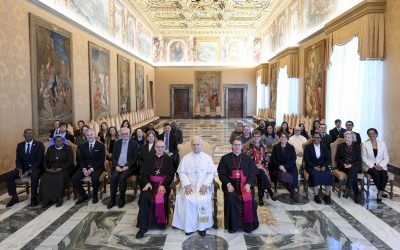
The body of 15 thought leaders in safeguarding children, adolescents and vulnerable persons from the risk of abuse in church settings, gathered in the Commission’s spaces at Palazzo Maffei Marescotti in downtown Rome to review the synodal Instrumentum Laboris (i.e. first draft) of their 2024 Annual Report.
Slated for publication in Autumn, the report follows on from the pilot publication last year, the first of its kind. The pilot text evaluated the global churches’ efforts to implement measurable practices to prevent abuse and assist victims and survivors. Additionally, the implementation of measures through the lens of the four catholic principles of truth, justice, reparations to victims/survivors and non-reoccurrence. This year the focus turns to the concept of reparation: Can the harm caused by abuse be repaired? And if so, how?
A SPIRITUALITY OF REPARATION
Building on prior work with the Commission, Professor Smolin traced the progression from a secular notion of justice, typically associated with post-conflict societies, to a deeply ecclesial model that grounds reform in Catholic theology and pastoral practice fostered by the Commission for 10 years. He praised the Commission’s formal adoption of the term “conversional justice” in its Pilot Annual Report, calling it “a very positive step forward.”

“‘Conversional justice’ embodies the transformation of a secular legal concept operating outside of the Church to a Catholic theological concept and practice operating internally within the Church.” – Prof. David Smolin
Smolin framed conversional justice as “positive change within the Church, and within individuals,” that stems from the theological imperative of conversion, urged by Pope Francis in the protection of children. He connected this theological foundation with the Commission’s institutional placement within the Dicastery for the Doctrine of the Faith, emphasizing that the Commission “is speaking to the Church from within the Church, using the language and authorities of the Church.”
He underscored that this theological approach conceptualized as a new methodology “is appropriate, so long as the Commission is accorded the degree of autonomy and freedom necessary to its difficult mission.”
FROM DEVOTION TO ACTION
Smolin highlighted Pope Francis’ call for a “spirituality of reparation,” quoting the Pope’s address to the PCPM in May 2023:
“What is broken must not stay broken…Mending the torn fabric of past experience is a redemptive act, the act of the suffering Servant….This is the path of healing and redemption: the path of Christ’s cross…Now is the time to repair the damage to previous generations and to those who continue to suffer…” – Pope Francis
Three key theological ideas are outlined: Christ’s atoning death as the foundation of reparation; the gospel pattern of the innocent making reparation for the guilty; and the inseparable nature of loving God and loving neighbor.
Smolin noted that these themes are reinforced through Catholic devotion to the Sacred Heart of Jesus, especially in Pope Francis’ recent encyclical Dilexit Nos, which Smolin described as potentially forming “an inter-related core of some of Pope Francis’ most important teachings.”
“In Pope Francis’ teaching on the Sacred Heart, it is made very clear that making reparation to God and making reparation to victims are so intertwined that, not only are both necessary, but in fact, making reparation to victims is a form of making reparation to God.” – Prof. David Smolin
REPARING WHAT HAS BEEN BROKEN
Smolin outlined the wide-ranging harm inflicted by clerical sexual abuse—not only to survivors, but to families, Church communities, innocent clergy, and even children indirectly exposed to abuse scandals. Quoting the Catechism of the Catholic Church on rape, he reminded the Commission:
“Rape deeply wounds the respect, freedom, and physical and moral integrity to which every person has a right. It causes grave damage that can mark the victim for life. It is always an intrinsically evil act. Graver still is the rape of children committed by parents … or those responsible for the education of the children entrusted to them.” – Prof. David Smolin
Survivors, he said, “are not responsible for making reparations on behalf of the Church.” Instead, the obligation lies with Church leaders, particularly those not directly complicit in abuse or cover-ups. “This is designed to counter an understandable reaction that such Church leaders may have, that if they were not involved directly in those crimes and sins, why should they go out of their way to address them?” he said.
“The first necessity of repair is to stop the spiritual and emotional bleeding precipitated by the combination of abuse, enablement of abuse, and mishandling of reports of abuse.” – Prof. David Smolin
LISTENING AND APOLOGISING

Among concrete proposals, Smolin emphasized the importance of listening to survivors: “It is imperative that Church representatives, and especially Church leaders, listen to survivors tell their stories. The most reparative active listening does not immediately offer solutions or claim to fix or repair; it is the very act of engaged listening that best offers a first step and pathway toward repair.”
On apologies, Smolin made a clear distinction: “Apologies are an initial and inchoate step of reparation by the Church, and it may poison the apology to use it as an occasion to ask for forgiveness.” He warned against what he called “spiritual manipulation,” especially when forgiveness is prematurely requested from survivors.
He illustrated this danger through a case study titled The Parable of the Bad Catholic Priest, showing how apologies can backfire when tied to institutional self-interest rather than sincere acknowledgment of harm.
A ROAD MARKED BY ACCOUNTABILITY
On the topic of financial reparations, Smolin underscored the need to understand the diversified local expectations in different cultures, stressing that while money may serve symbolic or therapeutic roles in certain contexts, it should not be mistaken for true reparation.
“There can be no primarily financial or even bureaucratic solution. The extremely personal and intrusive nature of sexual abuse requires forms of reparation that are personal in nature.” – Prof. David Smolin
Smolin concluded with a call to humility and truth, invoking Scripture and Pope Francis’ words:
“A spirit of reparation thus ‘leads us to hope that every wound can be healed; however deep it may be. Complete reparation may at times seem impossible, such as when … loved ones are definitively lost, or when certain situations have become irremediable. Yet the intention to make amends, and to do so in a concrete way, is essential for the process of reconciliation.” – Pope Francis

0 Comments