
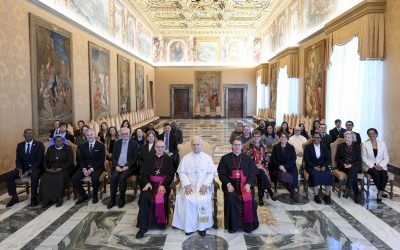
On Friday Novemeber 17, PCPM Secretary Fr. Andrew Small OMI addressed participants in the First National Meeting of Territorial SNTM Representatives, organized by the Italian Episcopal Conference CEI. Below is an English translation of the original text in Italian:
Vatican, 17 November 2023
First National Meeting of Territorial SNTM Representatives
Organized by the Italian Episcopal Conference
Address by Rev. Fr. Andrew Small, OMI
Secretary
Pontifical Commission for the Protection of Minors
I am very pleased to be with you today, on the occasion of the first national meeting of the Territorial Representatives of the National Service for the Protection of Minors and Vulnerable Persons in Italy. Networking is the key to carrying out this mission entrusted to us by the Pope to create a culture of care and protection within the Church. First of all, thank you very much for your work!
As I thought of addressing you here, the following passage from the Apostle Peter came to mind: “As living stones you also are built up as a spiritual edifice, for a holy priesthood and to offer spiritual sacrifices acceptable to God through Jesus Christ.” (1 Peter 2:5)
We all know that, by virtue of baptism, we form the ‘spiritual building’ of the Church, of which Jesus Christ is the cornerstone. As the Apostle argues, we are joined to this stone as structural, not ornamental elements. This makes us realize a first point: we are all necessary, we are all co-responsible.
Furthermore, the Apostle Peter speaks to us of a ‘priesthood’ that in our case is realized in the exercise of the ministry of prevention and accompaniment in the Church, in different roles: in welcoming victims through different channels of contact, or in organizing training meetings. These are all very important functions. I would like these words of Peter to resonate in a special way in the depths of our hearts today: our work is truly ‘A holy priesthood, pleasing to God!
We are called to create a culture of protection in the Church and to promote a culture of care in our relationships with each other, especially with children and vulnerable people.
At the same time, we are called by the Church to welcome and accompany victims and survivors on a path of individual and community care. As the Apostle says, we will do all this ‘through Jesus Christ’, that is, in union with him.
This union of hearts between us and Jesus speaks to us not only of a spiritual responsibility, but also marks what the style of work should be for each team, and for each of us, which takes the form of gentleness towards people, and care in implementing necessary procedures.
I would like to offer two points for reflection on our working methods, which are inspired by what the Holy Father proposed to the Pontifical Commission. One concerns the importance of accompanying people who have experienced abuse. He said:
Audience with the PCPM April 2022
The testimony of the survivors represents an open wound on the body of Christ, which is the Church. I urge you to work diligently and courageously to make these wounds known, to seek out those who suffer from them, and to recognize in those persons the witness of our suffering Saviour. For the Church knows the risen Lord to the extent that she follows him as the suffering Servant. This is the road that all of us must take: bishops, religious superiors, priests, deacons, consecrated persons, catechists and lay faithful. Each member of the Church, in accord with his or her proper state, is called to assume responsibility for preventing cases of abuse and to work for justice and for healing.
I am increasingly surprised at how – in many circumstances – the approach to pastoral care loses sight of its vocation to authenticity and true love of neighbor in the face of those who have experienced abuse committed by a member of the Church. It is hard to see that the instinct of ministers and pastors is often to seek the well-being of the institution rather than that of those who are suffering. Once again the Holy Father has offered us his wise guidance:
I encourage you to cultivate an approach that mirrors the respect and kindness of God himself. The American poet and activist Maya Angelou once wrote: “I’ve learned that people will forget what you said, people will forget what you did, but people will never forget how you made them feel”. So be gentle in your actions, bearing one another’s burdens (cf. Gal 6:1-2), without complaining, but considering that this moment of reparation for the Church will give way to a further moment in the history of salvation. The living God has not exhausted his sources of grace and blessing! Let us not forget that the wounds of the Passion remained on the body of the risen Christ, no longer as a source of suffering or shame, but as signs of mercy and transformation.
Audience with the PCPM April May 2023
I urge you to resist the appeals of those around you who want this period of reckoning to be over, who want us to stop talking about these matters. Our Holy Father recently spoke about this period in the life of the Church, aware that we have a fundamental ministry in it. Indeed, he stated:
Now is the time to repair the damage done to previous generations and to those who continue to suffer. This Easter season is a sign that a new time is being prepared for us, a new springtime, made fruitful by the work and tears we share with those who have suffered. That is why it is important that we never stop pressing ahead.
I reiterate my initial thank you, which was not circumstantial but very profound. I hope that the awareness of being ‘living stones’ of Jesus and exercising a ‘Holy priesthood’ will help us to approach our work in the service of the Church with a very deep sense of responsibility. May God bless you!
ENDS

0 Comments